

Lloyd Hopkin presenting the keynote and doing a wonderful job of persuading this audience of business leaders, educators and adult students to support our theory of change.
Project overview
The starting point for our research is a recent report by a UK government minister, Alan Milburn which addresses the question of why over million young people in the UK are currently not in work education or training.
Subproject 1 is an events programme designed for audiences in Wales – to present, test and refine our theory of change. Subproject two is more theoretical and develops a framework we can share with other nations in the UK and beyond that don’t share our National Curriculum in Wales. England and Wales are both nations in the UK but each has its own curriculum.
As such the project has two subprojects which address the same real world opportunity and problem from two different directions and a third subproject that brings them together. Via the combination of subprojects we aim to address gaps in education in Wales, England and overseas and boost future generations chances of living happy, healthy and prosperous lives.
Introduction – The Future of Work and what the picture looks like for young people finishing education today,
When it comes to getting a job, the messages bombarding the ears of our young people are filled with doom and gloom.
In the UK, a million young people are ‘NEET’, not in Education, Employment or Training. That is around one in eight young people, and the number is rising. No wonder young people are gloomy: Every advertised job gets hundreds of applications and young people are competing with older adults who already have experience of work. And that’s not the last of it – the number of advertised jobs for new starters is dwindling because it’s cheaper and more efficient to give simpler tasks to AI.
It makes you wonder, if you’re 16-24 why bother getting up at all?
Alan Milburn’s investigation into why youth unemployment is so high explains that a growing proportion are “bedroom dwellers” – over the course of their education they have become separated from their places of learning and communities and are now trying to live their lives entirely online – from their personal devices at home. When they start looking for work, they are competing with hundreds of others for each job and frequently hearing nothing further – not even a rejection. The demoralising impact of feeling invisible and unwanted drives many to seek support with mental health. Milburn’s conclusion is stark: youth disengagement is a moral tragedy and an economic crisis for the UK.
What it means to live life to the full
Shortly we’ll introduce Howard Gardner’s Theory of Multiple Intelligences, the Curriculum for Wales and Swansea University’s system of 5Ps and explain how each of these help us to respond to that challenge, but first there’s a stereotype we intend to challenge that people who work with their minds alone must be more intelligent than people who also work with their hands. We see the stereotype in practice when universities are branded as where you go if you like to focus on “brain work” and technical training as where you go if you prefer to put on a hard-hat, keep moving and leave thinking to other people to do.
The reality is that the world always needs ‘thinkers and doers’ and life is never simply one thing or the other and people are at their best when they hold these in combination. Builders on site can and should be encouraged to see and prevent accidents before they happen. Learning to be an engineer at school or university includes time tinkering with equipment. Composers write music in their minds because they live in a world of real instruments. Historians discover new ways to talk about the past – because they know how it feels (good and bad) to have critics respond to their work. We are physically, socially and spiritually embedded, relational and agentic in the world. And Education and Employment go hand in hand with many people returning to Education after a period in work.
Why this matters: The Curriculum for Wales (project 1)
The Milburn report demonstrates that post-Covid we have slid into a world where there are young people missing out on the essential value of a full life’ for their mental health, sense of value, spiritual growth and access to employment opportunities. Curriculum for Wales gives teachers a vision for education and aims for what it achieves rather than a detailed prescribed list of topics and content. Teachers are directed to plan a curriculum that achieves four purposes and will give young people what they need to be:
- ambitious, capable learners, ready to learn throughout their lives
- enterprising, creative contributors, ready to play a full part in life and work
- ethical, informed citizens of Wales and the world
- healthy, confident individuals, ready to lead fulfilling lives as valued members of society
This makes Wales a superb choice for where we develop a curriculum, tools and assessments that make explicit a view of intelligence that is relevant for our time. It is instructive to compare the ‘four purposes’ of Education with the ‘Bedroom dweller’ who is at the heart of the economic and moral crisis that Milburn describes in his report.
| The Purposes of Education in the Curriculum for Wales are for learners to become | The outcomes of Education for Young People who are ‘NEET’ |
| ambitious, capable learners, ready to learn throughout their lives | Unambitious learners, separated from their places of learning and unconvinced that education opens doors to better futures. |
| enterprising, creative contributors, ready to play a full part in life and work | Introverted, closed-minded contributors, disconnected from in-person opportunities to discover meaningful roles in life or work and suffering poor mental health after repeated rejection. |
| ethical, informed citizens of Wales and the world | Disengaged individuals who feel culturally and socially irrelevant, with little sense of belonging to Wales or the wider world. |
| enterprising, creative contributors, ready to play a full part in life and work | Isolated, anxious individuals, lacking confidence, wellbeing and purpose, and feeling undervalued by society. |
International Work (Subproject 2)
Gardner’s Theory of Multiple Intelligences is a game changer for a project such as this one – which argue that the value of education is far richer than many formal frameworks and summative assessments currently acknowledge – and that ‘now is the moment’ for revising them. The case for ‘why now’ is the need to give young people frameworks that restore what we lost during Covid and that go further to explicitly recognise ways of reasoning and contributing that are poorly represented by ‘pen and paper’ testing. The bases for these arguments are:
Students studying science during lockdown were given very little opportunity to do practical work which reduced their understanding of science as a discipline and enthusiasm for the subject. Many nations include assessments strategies in science to capture its practical nature and largely this argument is about restoring what was lost.
In the classroom, teachers design lessons that are experientially rich and varied to keep children motivated and engaged. During lockdown, education was reduced to what you can do at a screen. Some children ‘switched off’ and were lost to Education. Now that we are in a world that has established off-campus learning as an option, we argue that we need to press home the point that a rich and varied school life is more than only ‘nice to have’. Our project aims to do this by identifying multiple forms of ‘intelligence’ and by devising assessment strategies that explicitly recognise how education boosts students’ intelligence though activities such as in-person collaboration. Gardner’s current theory goes a long way with demonstrating how this can be done. Our version is ‘made for and in our time’ to help schools boost what we have lost post-Covid and incorporate new strategies and activities to prepare young people for the age of GenAI.
Howard Gardner encouraged educators to think beyond a narrow conception of intelligence. Rather than replacing existing curriculum intelligences, we can build on this insight by identifying additional intelligences that have become increasingly important in an age shaped by social fragmentation, technological change and the lessons of lockdown.
Importantly, these intelligences are not new subjects.
They are capacities developed across many subjects and experiences.
Interpersonal Intelligence
How I relate to other people.
This includes communication, collaboration, empathy, friendship, teamwork and the ability to work constructively with others.
Risk if weak: Social isolation.
Intracommunity Intelligence
How I understand myself as belonging within a community.
This includes participation, contribution, civic engagement, responsibility and a sense of belonging.
Risk if weak: Lack of belonging.
Interspatial Intelligence
How I navigate unfamiliar places and environments.
This includes confidence in new settings, wayfinding, exploration, mobility and independence.
Risk if weak: Reduced independence and confidence.
Intraspatial Intelligence
How I understand my place within the wider universe.
This includes awe, wonder, perspective, significance and encounters with questions larger than oneself.
Risk if weak: Lack of awe, perspective and purpose.
Alternatives Intelligence
How I recognise that things could be otherwise.
This includes questioning assumptions, considering different perspectives, imagining alternatives, identifying opportunities for change and envisioning better futures.
Risk if weak: Inability to imagine a positive future.
AI Savvy Intelligence
How I understand and direct artificial intelligence.
This includes understanding the strengths and limitations of AI, recognising how AI differs from human beings and using AI as a tool rather than treating it as an authority.
Risk if weak: Becoming controlled by technology rather than directing it.
Reading Milburn Through an Intelligence Lens
These additional intelligences are not included because they are fashionable. They are included because their absence helps explain some of the outcomes that concern policymakers.
| Intelligence | Risk if Weak |
| Interpersonal | Social isolation |
| Intracommunity | Lack of belonging |
| Interspatial | Reduced independence and confidence |
| Intraspatial | Lack of awe, perspective and purpose |
| Alternatives | Inability to imagine a positive future |
| AI Savvy | Becoming controlled by technology rather than directing it |
The “bedroom dweller” described by Milburn can be understood through this lens.
The young person is isolated from others. Their Interpersonal Intelligence is underdeveloped.
They no longer feel part of school or community. Their Intracommunity Intelligence has weakened.
They lack confidence moving into unfamiliar environments such as workplaces, colleges or new social settings. Their Interspatial Intelligence has diminished.
The future appears closed rather than open. Their Alternatives Intelligence is struggling.
The issue is not a lack of examination grades alone. It is a broader deficit in the capacities that support participation in society.
A Year 8 Test Case
The practical advantage of this framework is that it does not begin by demanding new subjects.
Instead, it begins by examining the curriculum that already exists.
Take a typical Year 8 timetable containing English, Mathematics, Science, Geography, History, Languages, Art, Drama, Music, ICT, Design Technology, RVE and PSHE.
For each lesson, we can ask four questions:
- What is the primary intelligence being developed?
- What additional intelligences are also being developed?
- Which of these are currently assessed?
- Which remain invisible?
For example, a science practical develops Scientific Intelligence. It may also develop Interpersonal Intelligence through teamwork, AI Savvy Intelligence through discussions of emerging technologies, and Intraspatial Intelligence through astronomy and cosmology.
A geography fieldwork activity develops Geographical Intelligence, while also contributing to Interspatial Intelligence, Intracommunity Intelligence and an understanding of place.
Drama develops Performative Intelligence, but may also strengthen Interpersonal Intelligence and Intracommunity Intelligence.
The point is not that these intelligences are absent from schools.
The point is that we rarely notice them.
From Curriculum Replacement to Curriculum Correction
The proposal is therefore not to replace Mathematics, English, Science or any other subject.
Nor is it to create six additional curriculum areas.
Instead, it is to look beneath the timetable and examine the full range of intelligences that learners are developing through their educational experiences.
Once these intelligences become visible, schools can identify gaps.
Some may discover strong provision for Mathematical, Linguistic and Scientific Intelligence, while offering fewer opportunities to develop Intracommunity, Intraspatial or Alternatives Intelligence.
Only then should additional projects, enrichment activities or curriculum experiences be introduced.
The goal is not expansion.
It is correction.
Conclusion
Curriculum for Wales provides an opportunity to rethink what educational success looks like.
The traditional curriculum already develops important intelligences and should continue to do so. However, the lessons of lockdown and the persistence of NEET outcomes suggest that some of the capabilities most closely associated with belonging, confidence, participation, hope and future orientation are often left unnamed and unassessed.
A new and creative curriculum can be explicit about the value of developing intelligences that help students to connect, belong, navigate, wonder, imagine alternatives and direct powerful technologies towards human purposes.
HOW – AND THE ROLE OF TECH
The design and introduction of new technologies and pedagogies is central to our project.
Children’s mathematical intelligence is a major priority in schools and there is a plethora of devices and activities available to support this aspect of development. At the same time, most if not all the devices that are widely in use including tablets, laptops and calculators are designed for one child at a time. The next generation of these tools is even more individualised as personal AI assistants are built directly into them. This matters as the focus on solitary work leaves schools still searching for ways to address a stubborn post pandemic crisis around social anxiety and school avoidance. The Calculator Dance mat is designed to boost children’s development in areas of intelligence that working with personal devices neglect – including the confidence to work with others, to communicate clearly, and to feel that they belong in their classroom community. That’s where the Calculator Dance Mat comes in. It is a very low cost supersized floor‑based keypad made from number and function tiles that children step on. Teachers can make their own, using materials in school or come to us for support with sourcing materials. The Calculator Dance Mat combines the development of children’s maths skills with the opportunity to add puzzles and games that boost these other aspects of development. It can be used in ‘performance mode’ where children use the keys to create mathematical dances and in classroom mode where they are working as a group to solve puzzles and carry out calculations. So that we can track and assess the impacts of our interventions, we are labelling as another branch of intelligence – children’s capacity for in-person sociability and collaboration.
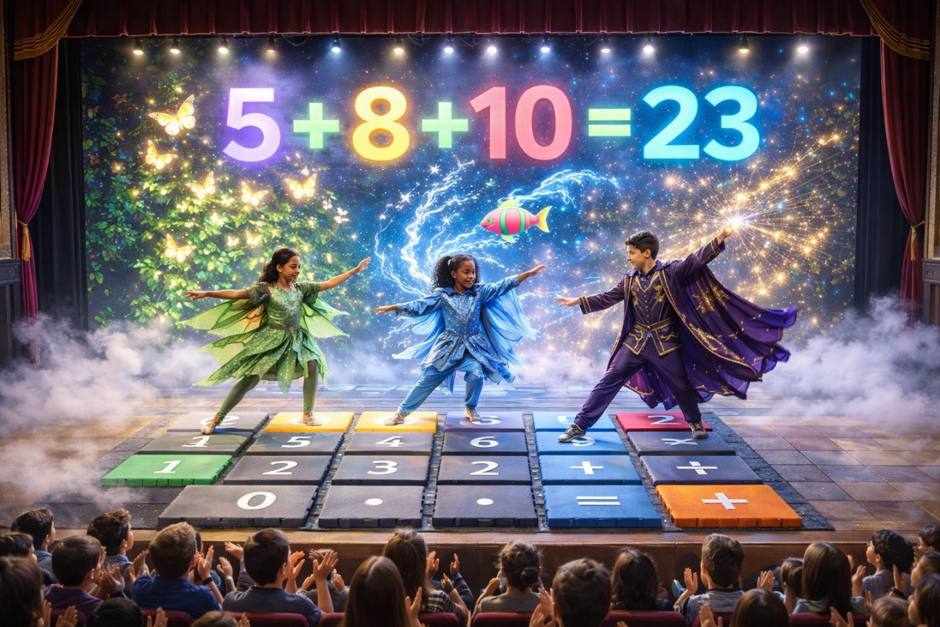
The image above depicts the Calculator Dance mat in performance mode. It was created by Berry Billingsley using GenAI
At our launch event participants tested another activity and technology that we have started to trial in primary schools – the Binary game.

We practiced together – in pairs – with each of our four hands representing a binary number (1, 2, 4, 8) and discovered we could count to 15 by raising our hands in sequence. The technology we add to this activity consists of a set of four microbits (little gadgets available in most schools and easy to order from school suppliers) It means that players can be set puzzles and the computer shows whether they have the correct answer.
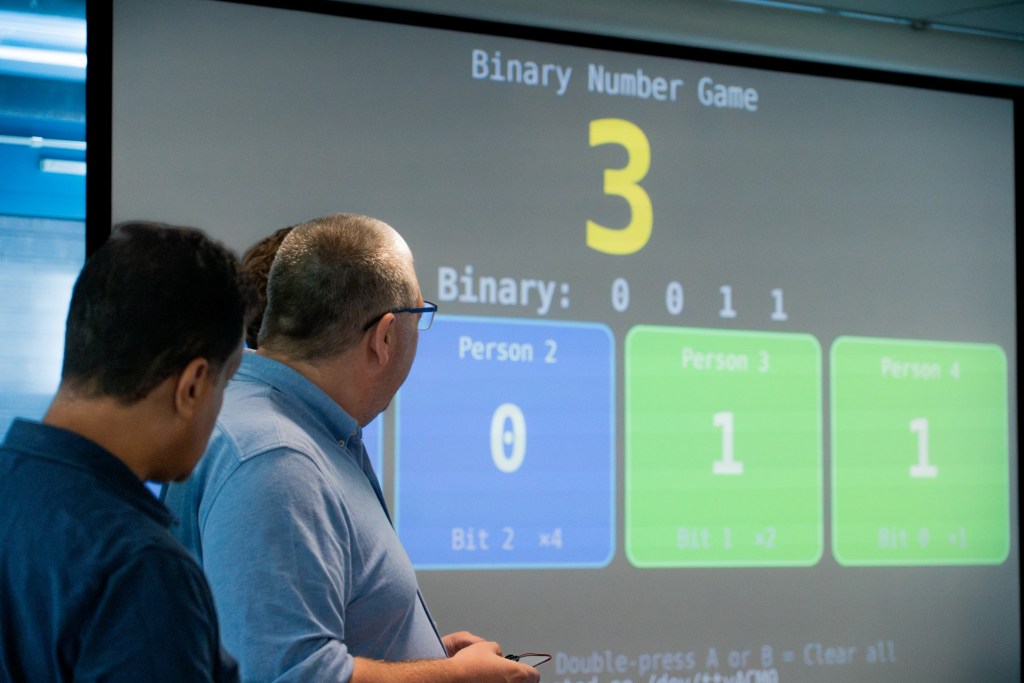
hand raised to depict the number value